
Breaking New Ground in Noma Surgical Care
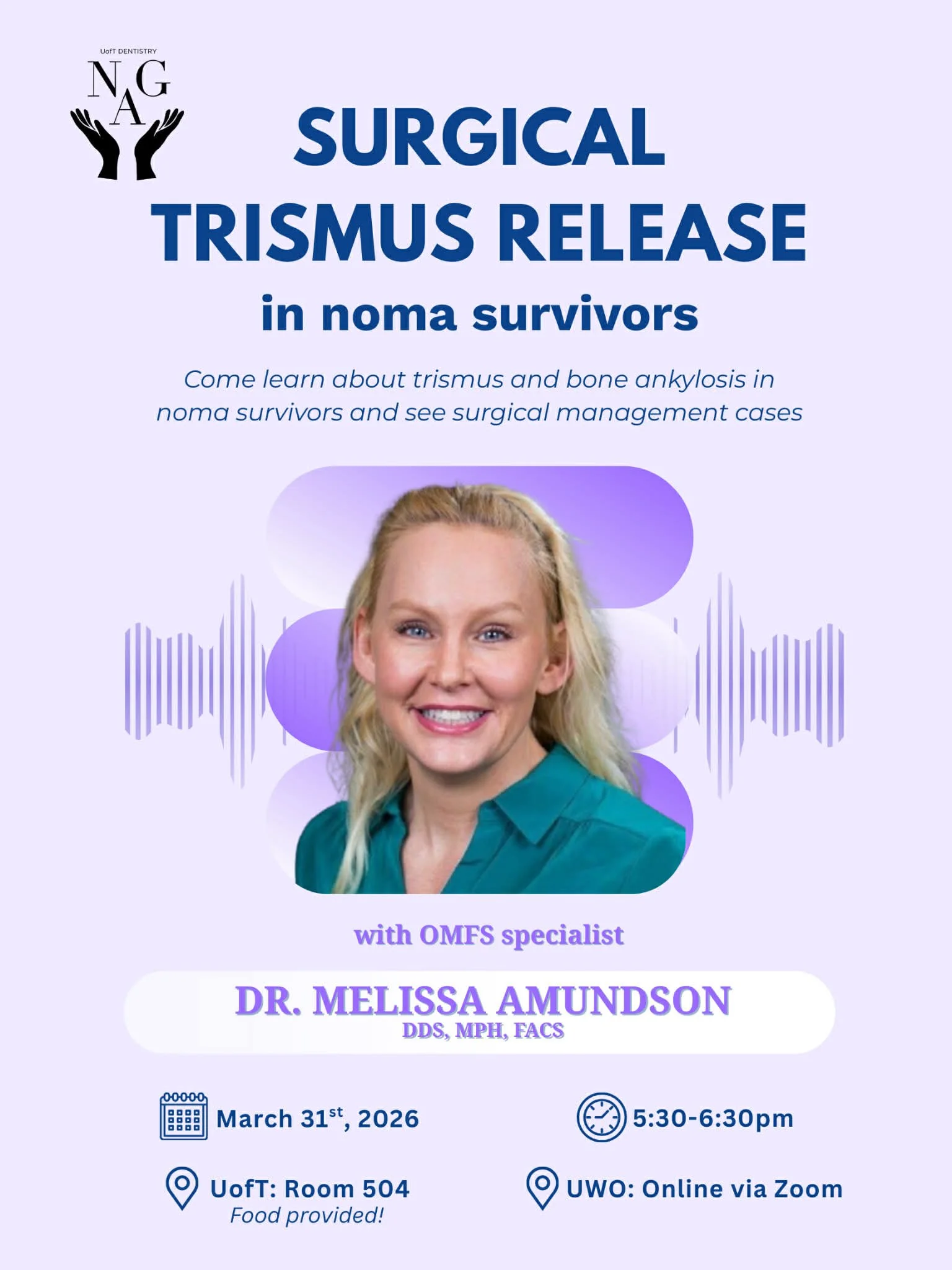
We were thrilled to welcome back Dr. Melissa Amundson for an eye-opening and inspiring talk on one of the most greatest challenges facing noma survivors: trismus and bone ankylosis.
Noma is a devastating disease, and for many survivors, the journey doesn't end with survival. Severe scarring and bony fusion can restrict mouth opening, affecting a patient's ability to eat, speak, and live comfortably. In fact, approximately 75–80% of noma patients with mid-face defects experience trismus; yet it remains widely overlooked and poorly understood.
The Problem with Existing Classification Systems
Dr. Amundson opened with a look at the tools currently available to surgeons. The NOITULP classification, introduced in the 2006 book Surgical Treatment of Noma, attempts to categorize soft tissue defects but falls short by reducing the complexity of the cheek to just its outer and inner lining, not being able to account for deeper structures and the broader oral cavity. A prospective outcomes study in Sokoto, Nigeria confirmed these concerns, finding poor inter-rater reliability raising questions about its usefulness as an objective outcome measure. Similarly, the T0–T4 trismus classification treats ankylosis as a simple “yes” or “no” finding, ignoring adhesions within the joint, the location of ankylosis, and the degree of soft tissue contracture.
Why Past Approaches Have Failed
These gaps have led to real reconstructive failures. The deltopectoral flap, once commonly used, restores only the outer skin layer, leaving deeper structures unaddressed. In one case, a patient who underwent osteotomy alone showed no improvement five years later. The core issue went back to a failure to anticipate the full scope of the defect leads to insufficient soft tissue volume and recurrence of bony fusion. A review of noma papers from 2010–2019 further highlighted the problem, none met the standard for proper study design, reflecting how underdeveloped this area of research remains.
A More Comprehensive Surgical Approach
Dr. Amundson outlined a clearer treatment algorithm starting with soft tissue excision, followed by comprehensive ankylosis release including bilateral coronoidectomy, assessment of the zygomatic arch, pterygoid plates, and temporomandibular joint. TMJ management may range from simple manipulation to full gap arthroplasty depending on complexity. The goal is 40mm of mouth opening before leaving the OR, followed by aggressive physiotherapy and soft tissue reconstruction over three to four months, or more. Surgeons must think big, anticipate large defects, and clearly distinguish between maxillary and mandibular involvement.
A New Classification System for Bony Fusion
To address the lack of standardized diagnosis, Dr. Amundson presented a new classification for synostoses in noma, Types I through VI, developed through CT scan analysis. This system accounts for varying types and locations of bony fusion, helps surgeons predict the underlying union preoperatively, and provides frequency data to better educate future surgeons.
Looking Ahead
The emergence of robust classification systems and treatment algorithms marks an important step forward: moving the field beyond the oversimplified label of "trismus" toward standardized, effective care for noma survivors worldwide. We are so grateful to Dr. Amundson for continuing to share her expertise and dedication with our community.